


For experienced hires and career changers
Out of practice? Get back up to speed before your assessment.
Haven't taken a timed aptitude test in years? Start with a short diagnostic, then use brief daily sessions to revisit numerical, verbal and reasoning questions before your assessment.
iPhone, iPad and any web browser. Questions, explanations and screens are in English. No account needed.
Sound familiar?
Where you might be right now
- A recruiter or employer has sent you an online assessment link
- Your last timed test was at university, and mental arithmetic feels rusty
- You are working full time and can only practise in short gaps
- You are moving into a new field and are not sure what the test will look like
Inside the app
See what you'll practise
Real screens from ACE-Test. Every question has a clock, a two-step hint and a worked explanation.
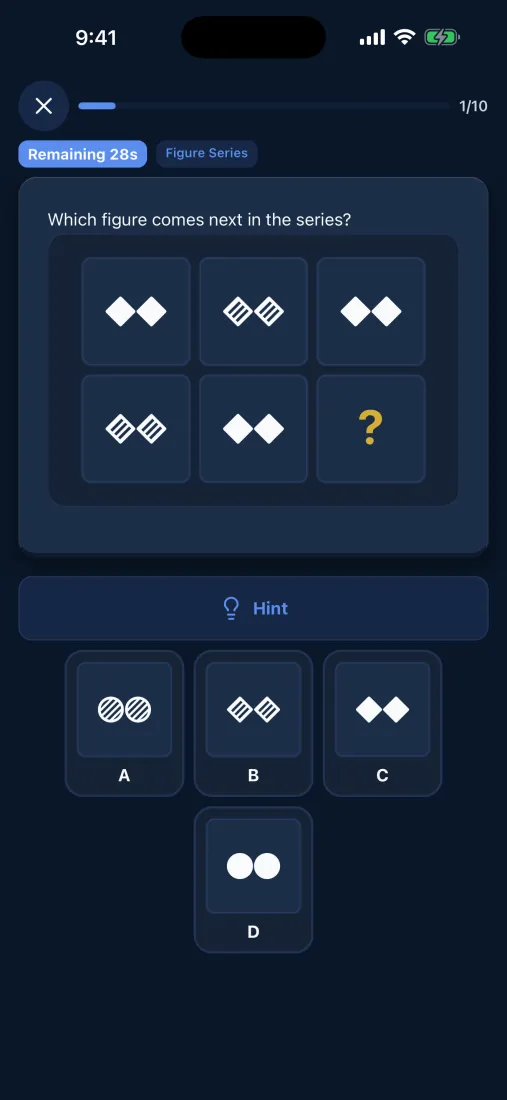
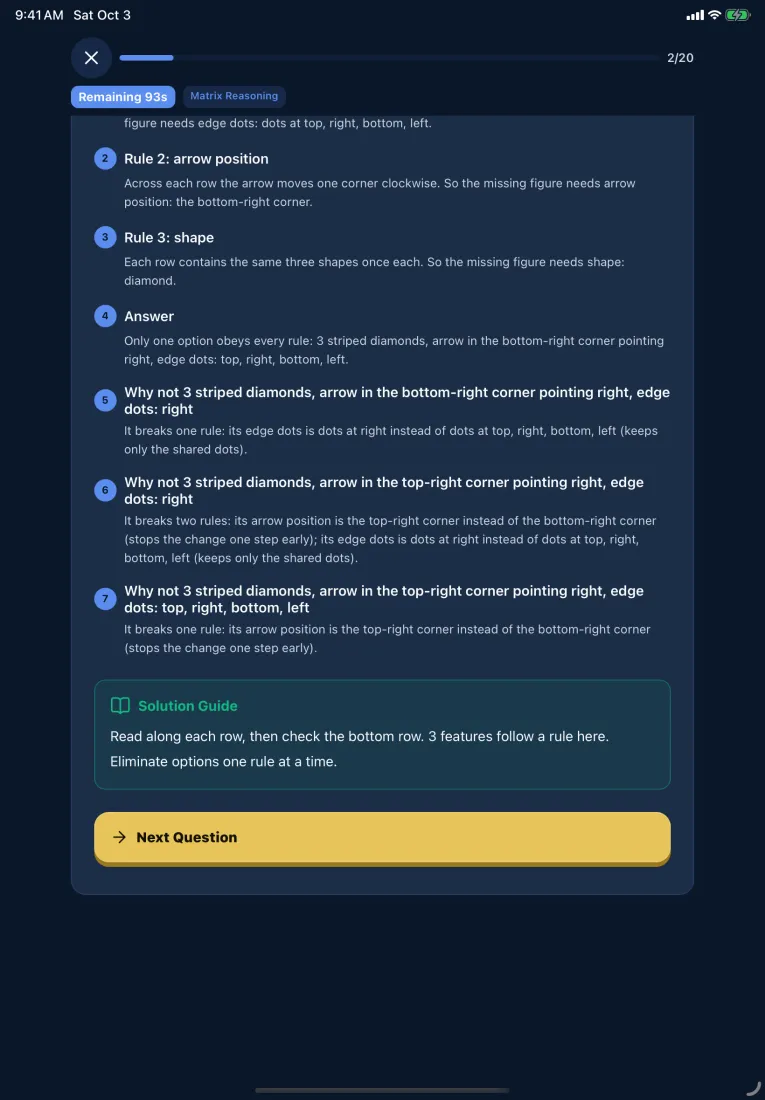
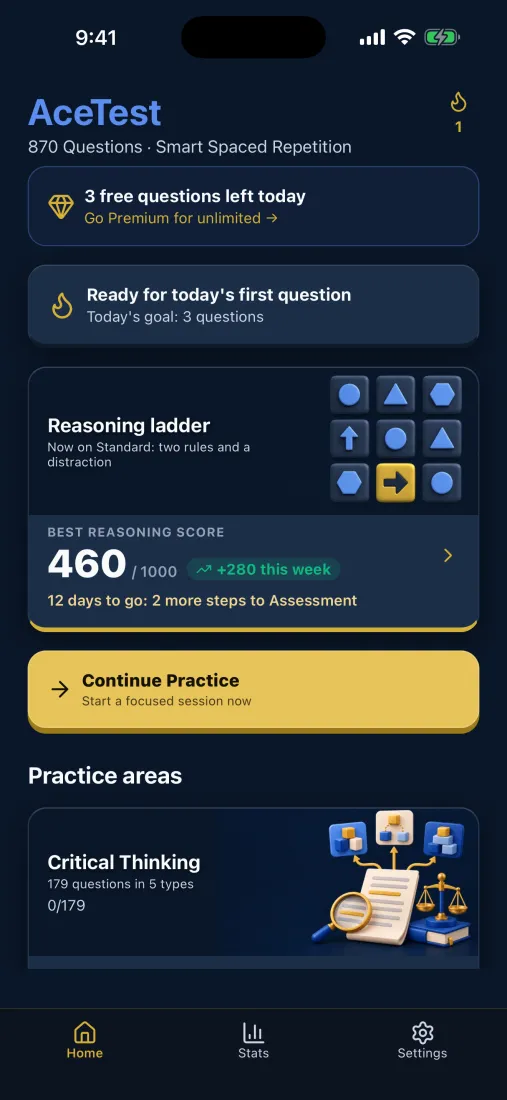
- 870
- original practice questions written for online aptitude tests
- 253
- of them with charts, tables, grids or figures
- 7
- general aptitude sections, from abstract reasoning to data interpretation
- 3
- graduate-recruitment formats: critical thinking, situational judgement and verbal true/false/cannot say
Start free
Start free. No account needed.
Everyone gets these, with no time limit. Premium is for when you want to practise as much as you like.

A 5-question diagnostic
Five test-level questions on one clock, with no easy warm-ups mixed in. See your first result and the formats that trip you up. Free, as often as you like.

3 practice questions a day
Pick any section, including the graduate formats. Every question you answer comes with hints and a step-by-step explanation.
Your mistakes, explained
Explanations for the questions you got wrong are never locked behind a paywall. See exactly where your method broke.

The eve-of-test review
The key points to look at the night before, plus the questions you missed in the last 14 days, on one screen.
Your plan
How long until your test?
Choose the time you have left. Every plan includes steps you can do for free. Where a step needs Premium, it says so, with a free alternative.
1. Week 1
Take the diagnostic to find your weak formats. Do 3 questions on your commute or lunch break.
2. Week 2
Drill your weak formats. Premium: sit one full timed mock test at the weekend.
Pricing
Free to start. Premium when you want more.
Select your App Store country to see the price. If your country is not listed, the App Store shows your local price before you buy.
Free
£0
No account, no time limit
- 5-question diagnostic
- 3 practice questions a day
- Your mistakes explained
- Eve-of-test review
Weekly Premium
£4.99 a week
Renews automatically every week until you cancel
Lifetime Access
£19.99 once
One-off payment. No subscription, no expiry
Both Premium options unlock the same features: all 870 questions with no daily limit, timed mock tests, spaced repetition and a plan paced to your test date.
You can upgrade inside the app at any time, or in your browser with the same prices. Prices in other countries are shown in your local App Store.
- Weekly Premium renews automatically each week until you cancel. In the App Store, cancel at least 24 hours before the end of the current week to avoid the next charge. If you bought in your browser, cancel any time from the Manage subscription link in the web app or your receipt email; Premium stays on until the end of the week you paid for.
- Lifetime Access is a single payment that unlocks the same Premium features with no expiry.
- If you expect to practise for four weeks or more, Lifetime Access costs less than paying weekly.
- ACE-Test runs as an iPhone and iPad app and in any web browser, so Android users can practise in the browser version now. The Android app is coming to Google Play.
- App Store purchases are refunded through Apple at reportaproblem.apple.com.
- Web purchases are processed by RevenueCat with payment by Stripe. Prices are the same as in the App Store.
- Premium bought in your browser works in any browser where you sign in with the same email. It does not yet unlock the iPhone and iPad app, and App Store purchases do not yet unlock the web app.
How results are used
How employers use these tests
Every organisation runs its own process. This is how tests are commonly used, not a description of any particular employer.
Used for experienced roles too
Many employers use online tests for experienced and lateral hires as well as graduates, alongside CV screening and interviews, as a consistent way to compare candidates.
The mix depends on the role
Roles that work with data tend to weight numerical reasoning, while roles that work with documents and policy tend to weight verbal reasoning. Senior roles may add judgement-based formats.
Short deadlines
The window between the invitation and the deadline can be only a few days, so it pays to look at the formats as soon as you start applying.
From our founder's coaching sessions
Advice he gives the people he coaches
Don't open each role with just the company name and job title. A reader who thinks 'that's not our industry' stops there. Lead with the themes that transfer, and use them as hooks so the interviewer asks about your best stories.
If you can't remember an exact figure, don't freeze. Round it, or give the proportion or rough scale. Silence suggests you weren't close to the work.
Don't just report results. Explain what you thought and what you did. Results depend partly on luck, but your thinking and your actions are what an employer can expect you to repeat.
Drawn from recorded one-to-one career coaching sessions by Takayoshi Watanabe. Details have been removed to protect the people he coached.
Know the test
What online aptitude tests measure
Employers combine these question types in different ways, and each publisher's test looks a little different. These are the families you are most likely to meet.
Numerical reasoning
Reading tables and charts, picking the numbers that matter and working out percentages, ratios and change. A calculator is often allowed, so the real test is spotting which figures to use, fast.
Verbal reasoning
Reading a short passage and deciding whether a statement is true, false or cannot be said. You judge only on what the passage says, not on what you happen to know.
Abstract and inductive reasoning
Finding the rule in a sequence or grid of shapes and choosing what comes next. There are almost no words, so it rewards a method for hunting rules more than language skill.
Logical and deductive reasoning
Drawing only the conclusions that must follow from the facts given: ordering, matching and combining conditions.
Critical thinking
Spotting assumptions, judging whether an inference holds and weighing the strength of arguments. Common in graduate and professional services recruitment.
Situational judgement
Reading a workplace scenario and rating how effective each response is. The right answer depends on the behaviours the employer is looking for.
The myth
"You can't prepare for these tests." Half true.
Practice will not transform your underlying reasoning ability overnight, and no honest app should promise that it will.
But some lost marks may have less to do with the abilities a test is meant to measure than with the conditions around it. Meeting a question type for the first time and burning a minute working out what it wants. Misjudging the clock and leaving the last questions blank. Nerves knocking out the method you normally use.
Those are preparation problems, and preparation is something you can do.
Familiarity
If you have seen the format before, you spend your time answering, not decoding instructions.
Speed
You learn what a minute per question feels like, and when to move on rather than dig in.
Nerves
Knowing you have done the work makes it easier to stay with your method under pressure.
Free checklist
Your test-day checklist
Useful whether or not you use ACE-Test.
As soon as the invite arrives
- If a disability or health condition affects how you take timed tests, ask the employer about reasonable adjustments as early as you can, before you start the test.
- If the invitation links to a practice test from the test publisher, take it. It is the best way to see the real screens and controls.
- Check whether your university careers service or employer offers free practice tests too, and use them alongside ACE-Test.
The day before
- Reread the invitation email. Check the deadline, the time zone and the test link.
- Check your device and browser against the employer's technical requirements.
- Find out whether a calculator and rough paper are allowed, and have them ready if so.
- Open the eve-of-test review in ACE-Test: the key points and the questions you missed in the last 14 days.
- Do not start new topics. Get a proper night's sleep.
On the day
- Turn off notifications and book a quiet slot where nobody will interrupt you.
- Check your battery and connection. Plug in a laptop if you can.
- Read the instructions screen carefully, especially how the time limit works.
- Do not get stuck. If a question is eating your time, pick your best answer and move on.
- Follow the instructions on guessing. Whether wrong answers cost marks depends on the test.
Our story
Why ACE-Test exists

Takayoshi Watanabe
Founder, RUOK LLC
- Head of Business Unit, Amazon
- Director, Salesforce
- Passed Country Head assessment, Bayer
- Passed Country Head assessment, Takeda
- Passed management assessment
Former roles and assessments; no affiliation with or endorsement by these companies.
I sat aptitude tests at promotion after promotion at global companies. People said you couldn't prepare for them. The results still counted.
I came to disagree with part of that advice. Practice won't change what a test measures. But you can get to know the question types, get used to working against the clock and learn from your mistakes, so that an unfamiliar format is not what decides the day. Read the full story
Free guides
Guides for every step before the offer

How global companies hire, step by step
A plain-English walk through the hiring process at large global employers: application and ATS screening, online assessments, video interviews, assessment centres, final interviews and offers. Typical timelines, what each stage screens for, the UK and Australian graduate calendar, and how experienced and internal hiring differ.
Read the guide
How to structure a CV or resume that gets read
How to build a CV that applicant tracking systems can read and recruiters can scan in seconds: layout, section order, the action + metric + result formula for bullets, UK and Australian CV versus US resume conventions, and cover letter basics.
Read the guide

CV advice by job family
What recruiters scan for in CVs for software engineering, data and analytics, finance and accounting, consulting, marketing, sales, operations and supply chain, HR, and graduate roles with no experience. Key sections, example bullet structures and common mistakes.
Read the guide

Using AI well, and honestly, in your job search
Practical, honest ways to use AI assistants in a job search: tailoring a CV to a job description, drafting STAR interview answers, mock interviews and company research, with example prompts. Plus what not to do, including fabricating experience and using AI during assessments.
Read the guide
What Google's careers site says about resumes
A short, sourced summary of the resume advice Google publishes on its own careers site, including the 'accomplished X as measured by Y, by doing Z' formula, and how to apply it to any application.
Read the guide
Build a stronger CV by talking it through with an AI voice assistant
A step-by-step workflow for using an AI voice assistant to interview you about each role, draw out achievements and numbers, turn them into X-Y-Z and STAR bullets, tailor them to a job description and finish with a mock recruiter screen. Copy-paste prompts included.
Read the guide
Free aptitude test preparation resources for students and careers advisers
A page careers advisers and L&D teams can share: common reasoning and judgement test formats, what to check before an assessment, reasonable adjustments, where to find free practice, and what ACE-Test does and does not offer for free.
Read the guide
FAQ
Questions people ask
Is it a disadvantage to take an aptitude test years after university?
Not necessarily, but many people are out of practice with timed arithmetic and shape puzzles. A short burst of practice helps you show your real level rather than your rusty one.
I only have ten minutes a day. Is that worth it?
Yes. ACE-Test works one question at a time with an explanation after each, so a commute or a coffee break is enough to make steady progress.
Will the interviewers see my test results?
It depends on the employer. Some use results only as a cut-off, others share them with interviewers. If the invitation does not say, prepare as if they will.
What can I use for free?
The 5-question diagnostic, up to 3 practice questions a day, explanations of the questions you got wrong and the eve-of-test review are free for everyone, with no account and no time limit. Premium adds unlimited practice, timed mock tests, spaced repetition and a plan paced to your test date.
Will practice guarantee a higher score?
No one can honestly guarantee that. Practice does not change your underlying ability overnight. What it can change is familiarity with the formats, your sense of timing and how calm you are, which are the things that cost people marks they should have had.
Are these the real test questions?
No. All questions are original practice material written by our team. ACE-Test does not reproduce any real test's questions, screens or scoring and is not affiliated with any test publisher or employer.

Out of practice? Get back up to speed before your assessment.
Practise the questions. Understand your mistakes. Walk in prepared.

Or practise in your browser, no download needed
ACE-Test questions are original practice material written by our team. They do not reproduce any real test's questions, screens or scoring, and ACE-Test is not affiliated with or endorsed by any test publisher or employer.